
Build personal context into your apps using Meta's new Data Portability tool
Go live in minutes with Fabric: power your app with personal context from Instagram stories, DMs, and more.

Your users have years of Instagram stories, posts, DMs, reels, and likes sitting at Meta. You can build Meta's personal context into your apps in minutes using Fabric.
Think of it like Google's Personal Intelligence, but instead of being tied to one ecosystem, you're layering personal context from Instagram, Google, YouTube, and many more platforms into your own app.
The result? Apps that understand your users perfectly from day one.
Here's how to go live with personal context in minutes with Fabric.
Meta has a rich history of supporting data portability
Meta has been a long time supporter of data portability. Its Download Your Information (DYI) tool allowed millions of people to export a copy of all their data from Meta’s platforms (Facebook only back then) onto their own computers.
This was followed, a few years ago, by a new Transfer Your Information (TYI) tool to allow users to transfer a copy of their photos and videos directly to other platforms, such as Dropbox, without the user needing to download the data locally and then uploading it to the destination.
In the last few months, the two tools have been merged into a new Export Your Information (EYI) tool which brings the best of both worlds.
The richness of a complete user archive, transferred programmatically to the destination desired by the user.
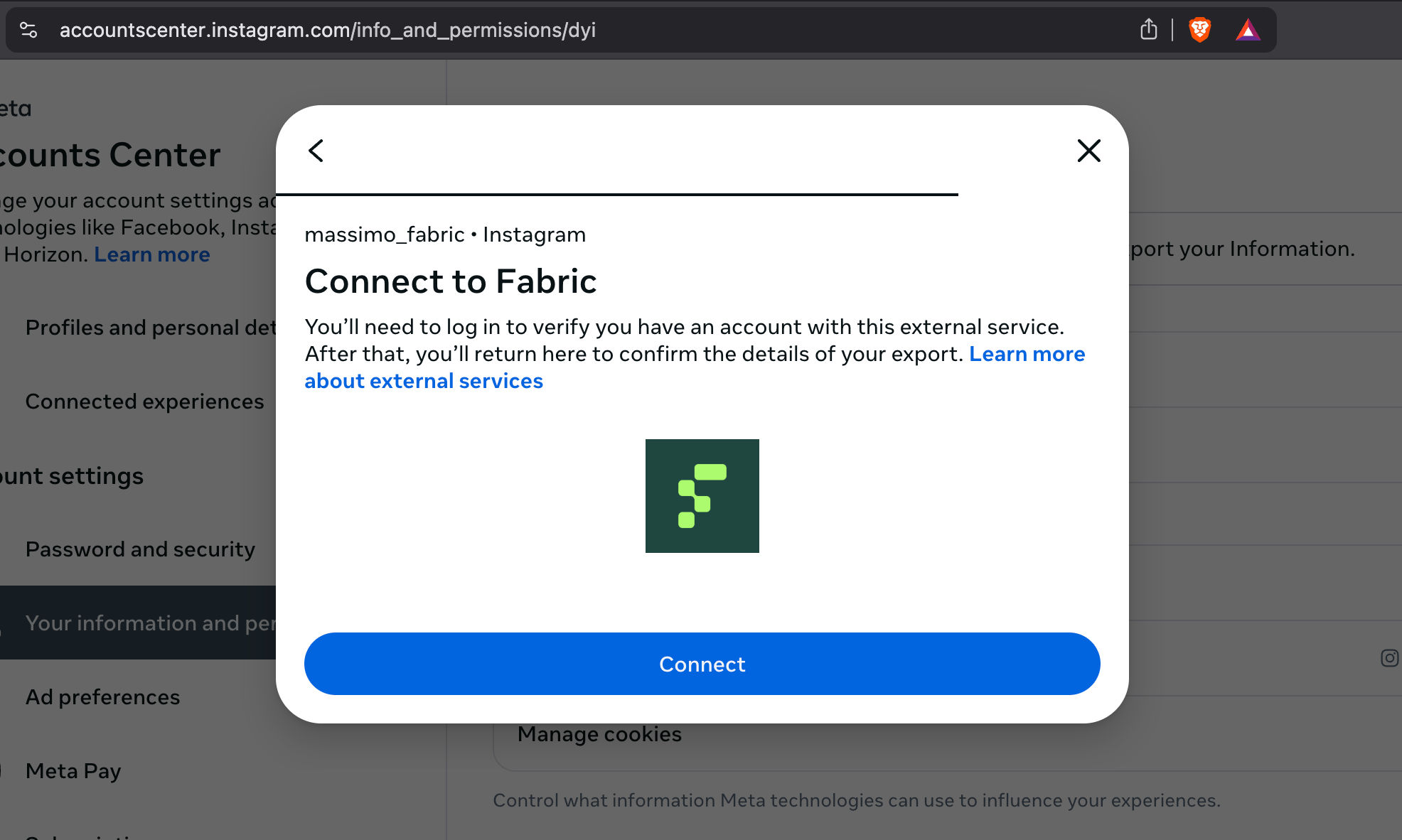
In just a few clicks, I can transfer a copy of my historical Instagram data to Fabric and also set up a recurring transfer to send all my daily data from that point.
Meta built the most engaging consumer products with their social graph. Now you can too
Meta built some of the most engaging consumer apps in the world. They did this so successfully by capturing an extremely detailed understanding of each of their users (preferences, social circles, activities, …) and used it to build experiences uniquely tailored to each one of them.
If you are a developer, data portability means your apps and agents can now access the same data Meta has about a user and use it to bring your experiences to the next level.
For all the developers building consumer agents, for example, accessing the Instagram stories posted by a user, their social graph, or even their DMs (for the brave ones) means turning agents from sophisticated chatbots into truly personal agents that understand you like a friend.
Using her Instagram data and Claude, my co-founder managed to replace her nutrition coach and food tracking app with a nutrition agent that she has been using daily for 2 months.
Literally everything I do on Meta's apps is available. My stories, connections, DMs, collections are all personal context for apps now
Here are some examples of what you can get:
all of the user’s Instagram stories, reels and posts
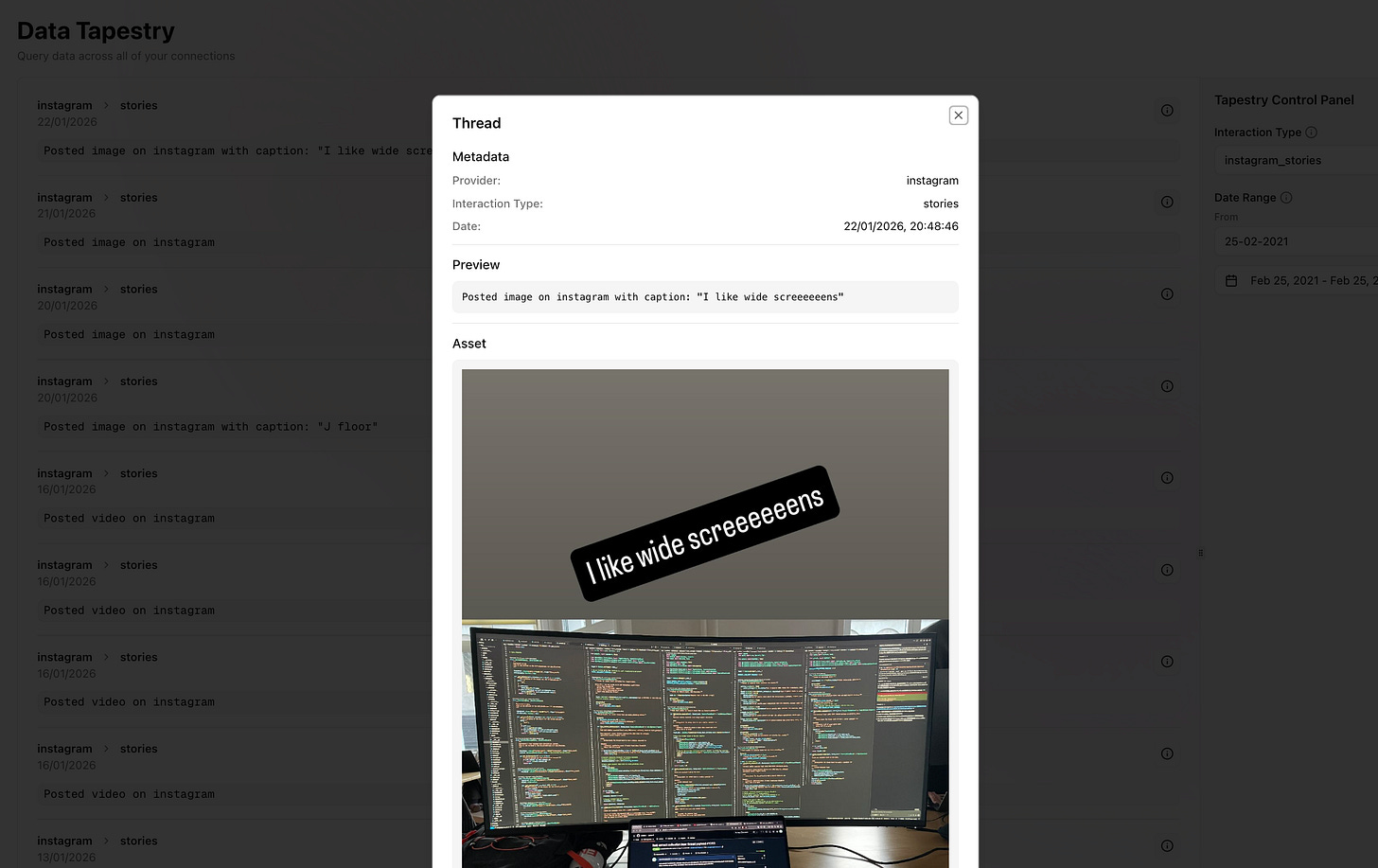
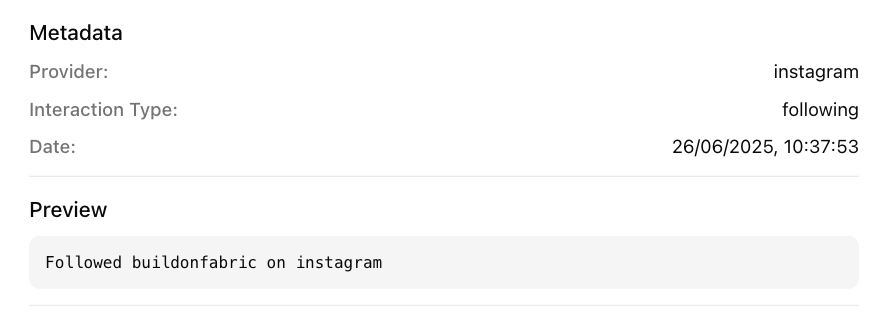
all of the user’s followers and following
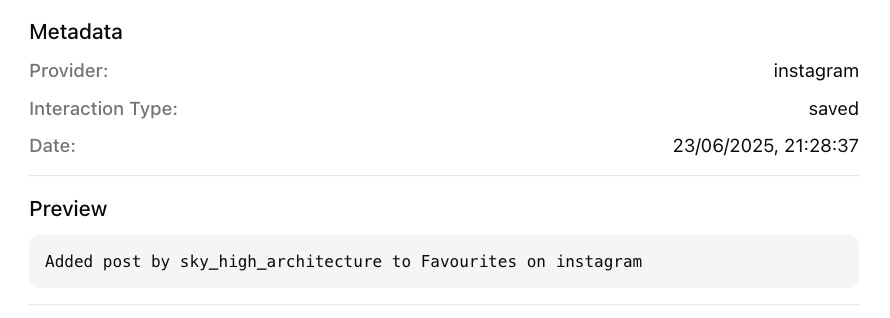
all of the posts the user saved
and much more (recently viewed shopping items, wishlist items, profiles searches, liked posts, ads viewed, videos watches, …)
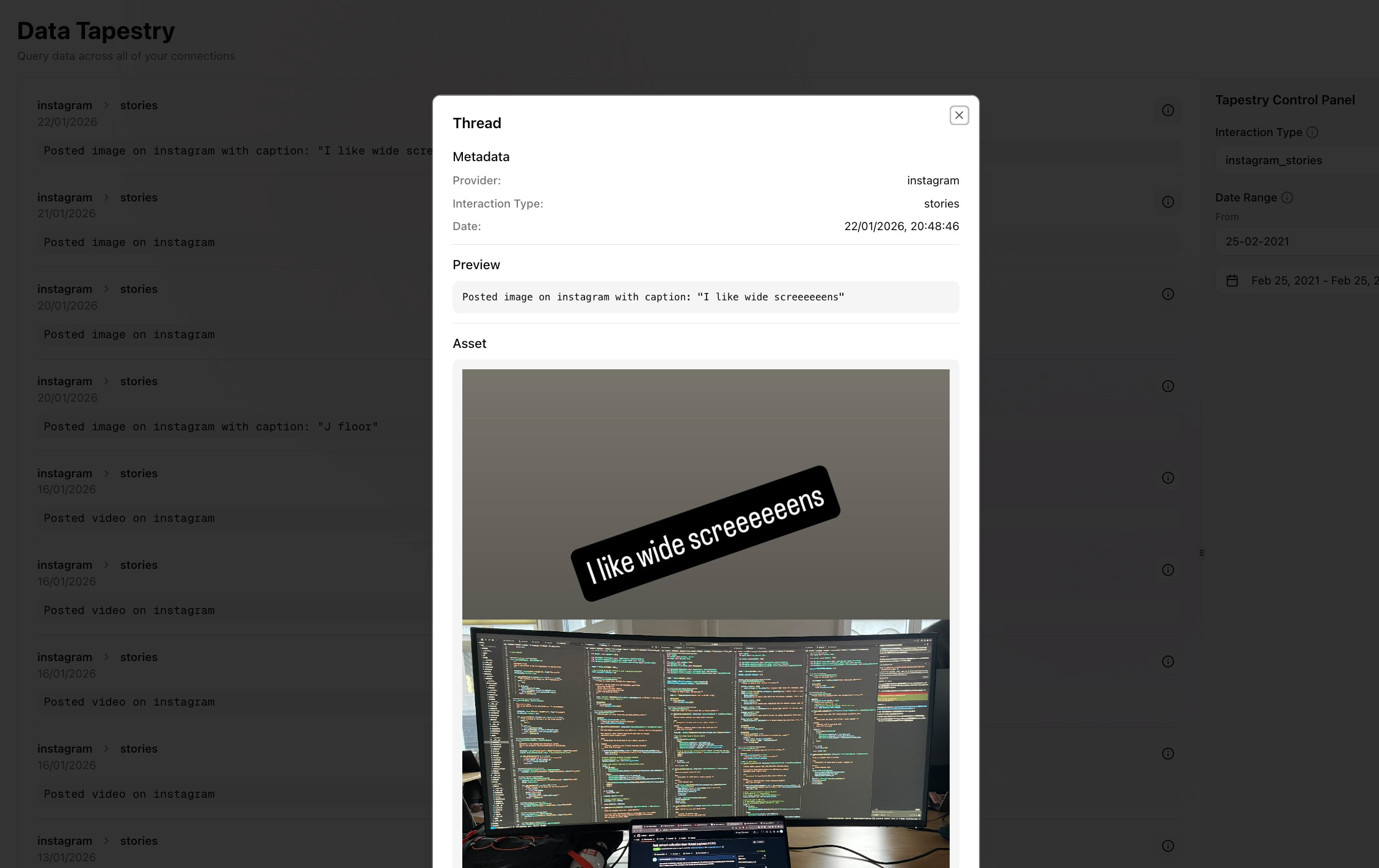
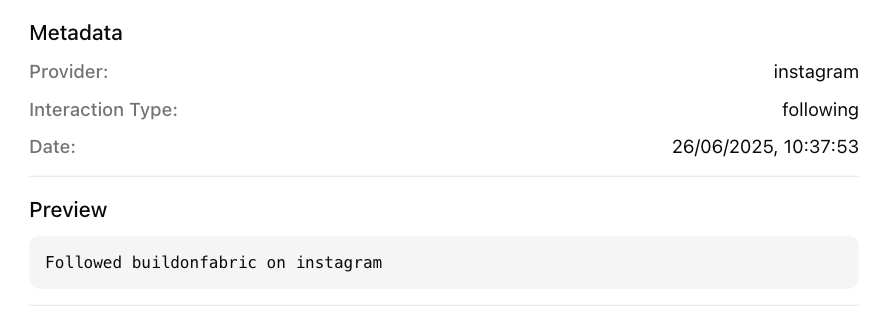
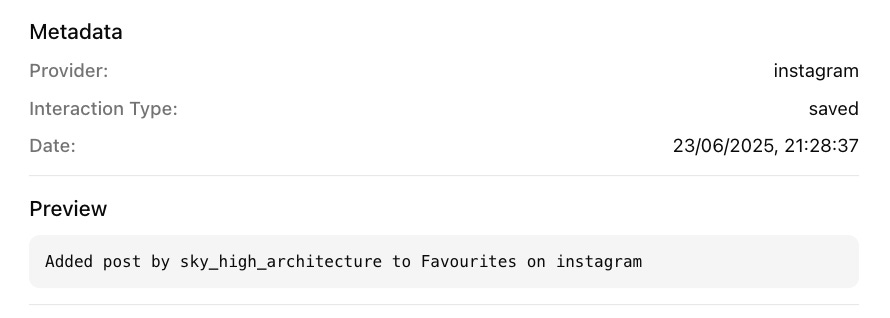
We transform all of the raw data we get from Meta and other platforms so that it follows a standard schema. Given its popularity in decentralized social networks, such as Mastodon and others, we chose W3C’s Activity Streams 2.0 as a model to represent online interactions on various platforms.
Start using personal context in minutes with Fabric
Fabric is the first company in the world to have been whitelisted onto DTI’s Trust Registry as Trust Level 2 (i.e. you can trust Fabric) and as a transfer destination of Meta’s new EYI tool.
We spent several months improving the integration to make it fast and reliable and we are now making it accessible to every developer in the world to build apps and agents using personal context.
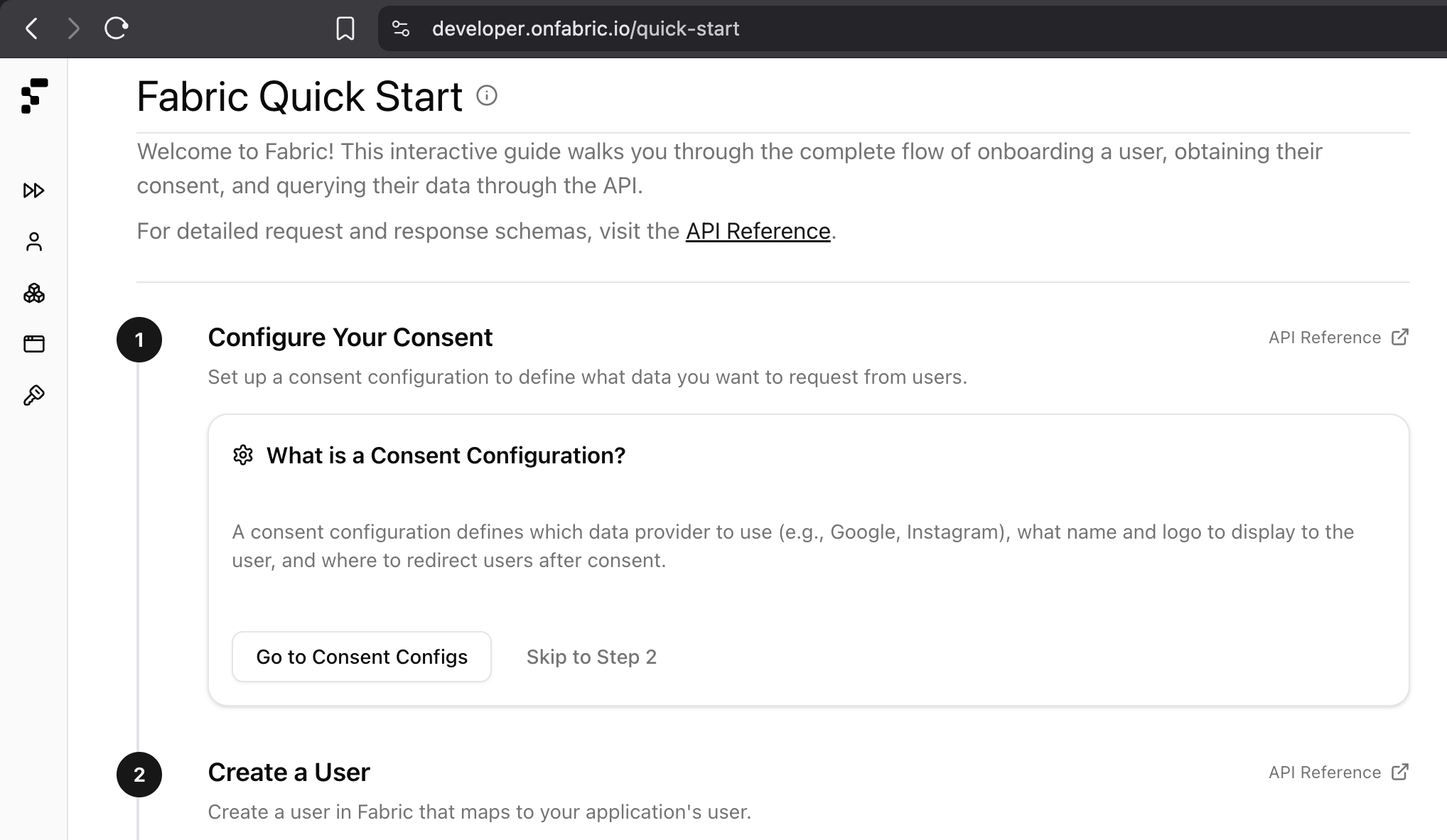
You can get started in minutes by following the quick start at https://developer.onfabric.io
Fabric creates contextual intelligence so data portability becomes useful for agents
After working with data from Big Tech platforms, we learned that personal user data when brought out of the platform where it was created loses a lot of its meaning and this makes it really difficult to build personalized experiences with it.
For instance, it is easy to imagine how to port a picture posted on Instagram to a storage service like Dropbox but how do we port a video I liked to another platform like X where that video doesn’t even exist?
Fabric solves this problem by distilling the raw data from Meta (and many other platforms) into an accurate understanding of each user that can be easily ported to any app and agent.
We call this Context Portability (as opposed to simple Data Portability) and we see this as the key enabler of consumer experiences that feel truly personal and AI agents that act more like friends and less like chatbots.
Fabric is building the Context Portability ecosystem. We are opening up our infrastructure to developers with a generous free tier
Fabric is committed to creating the Context Portability ecosystem, an ecosystem of apps and agents that building consumer experiences 1000x better than the status quo by putting a deep understanding of the user at the center thanks to data from all the Big Tech platforms.
Every single consumer vertical (fashion retail, dating, travel planning, …) is being rethought with AI and user context. Fabric allows consumer apps and agents to build experiences that are hyper-personalized from day 0 thanks to the rich user understanding already available in platforms like Meta.
We want to make it extremely simple to start building on top of rich user understanding and for this reason we are making all of our infrastructure available on a generous free tier for developers.
This is not meant to circumvent security audits and compliance. It’s meant to enable builders to go from 0 to context-aware consumer apps in the span of a hackathon, to give them enough room to test whether there is some growth potential.
Get started building context-aware consumer apps by signing up at https://developer.onfabric.io