
AI Memory Is Not Understanding, Context Curation Is
Because humans are far more than the sum of the messages they send to their AIs

Google just released Personalized Intelligence and made a revealing admission.
“Gemini may also struggle with timing or nuance, particularly regarding relationship changes, like divorces, or your various interests. For instance, seeing hundreds of photos of you at a golf course might lead it to assume you love golf. But it misses the nuance: you don’t love golf, but you love your son, and that’s why you’re there.
ChatGPT, Claude, and Gemini can already recall more facts about me (real, guessed, sometimes incorrect) than I can.
But they keep misunderstanding me. Recommending places I tend to visit for work as leisure trips and mistaking my Dad’s political opinions as mine (he keeps using my YouTube account)!
It’s because we are more complex than everything we have ever written, photographed, searched for, or witnessed.
Recall is not the same as understanding. Context curation is.
Context curation means intentionally combining your personal data (example, Instagram stories, Google searches, ChatGPT prompts) and adding your perspective. It’s the act of reflecting on what matters, explaining why it mattered, and connecting the dots in ways a model can’t guess on its own.
For example, combining my Google searches about European travel this summer with itinerary planning in Claude and Instagram stories from Capri can kick off a curation experience. It’s one that makes sense across all those systems and so must be portable by design.
Even with personal data, AI assistants will still miss nuance
Sam Altman recently spoke about the future of AI memory: how ChatGPT will infer subtle, unstated preferences and personalize across your entire life history.
Around the same time, Google released Personalized Intelligence, and admitted that even with access to all your Google data, Gemini still misses nuance and so you should correct it.
“…But it misses the nuance: you don’t love golf, but you love your son, and that’s why you’re there. If Gemini gets this wrong, you can just tell it (”I don’t like golf”).”
As a daily active user of ChatGPT, Gemini, Claude, Cursor, and many other AIs, the idea of truly personalized AI is music to my ears with an important caveat.
Having an assistant with superhuman memory is life-changing.
Having one with millions of inferred errors is terrifying.
You shouldn’t have to correct every single AI you use
When Gemini gets me wrong and I correct it…
Do I then have to independently correct ChatGPT, Claude, Meta AI, and Mistral?
And what about vertical AIs: for dating, shopping, health, or social?
Correcting many assumed versions of yourself scattered across products that don’t talk to each other quickly becomes absurd.
Context curation solves this problem.
You should be in charge of what AI knows about you
Assuming your preferences from your search history, messages, and photos is not the same as understanding someone like a friend. It’s a great starting point.
AI memory feels magical when it:
resurfaces something relevant you’d forgotten, or
creates latent connections you didn’t know existed
But when AIs make these creative connections, the margin for error is high.
The ultimate arbiter of what’s true about you must be you.
Curate your context so AIs don’t have to guess
Our goal is simple. Enable users to curate their context and bring it to all their AIs.
It starts with curation.
Think of it as co-authoring your autobiography. Fabric assembles the chapters and asks the questions, like a good biographer would.
But only you can tell your story.
Instagram might know that I went to a wedding.
Only I know the full story behind that Instagram story:
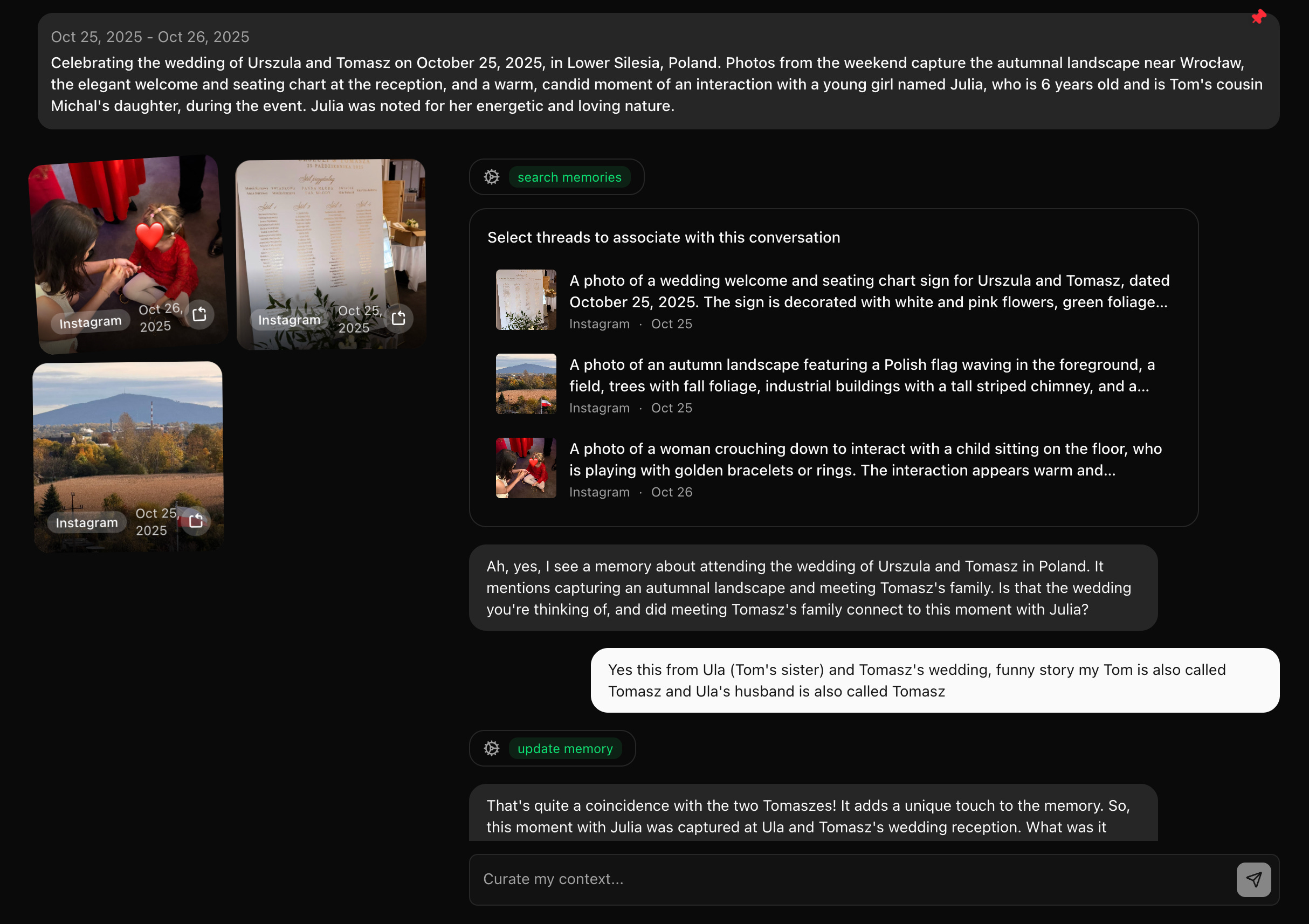
When Fabric prompted me to curate this memory, I responded to reflect on a meaningful moment in my life, revealing new details which couldn’t possibly have been guessed.
Curating your context is the best way to teach AI about you
Your context determines how AIs understand and serve you, whether it’s ChatGPT, Gemini, or Wabi.


Right now, Google knows the largest piece of you. Meta knows the social bits. Claude and ChatGPT know newer fragments. No one has the full picture.
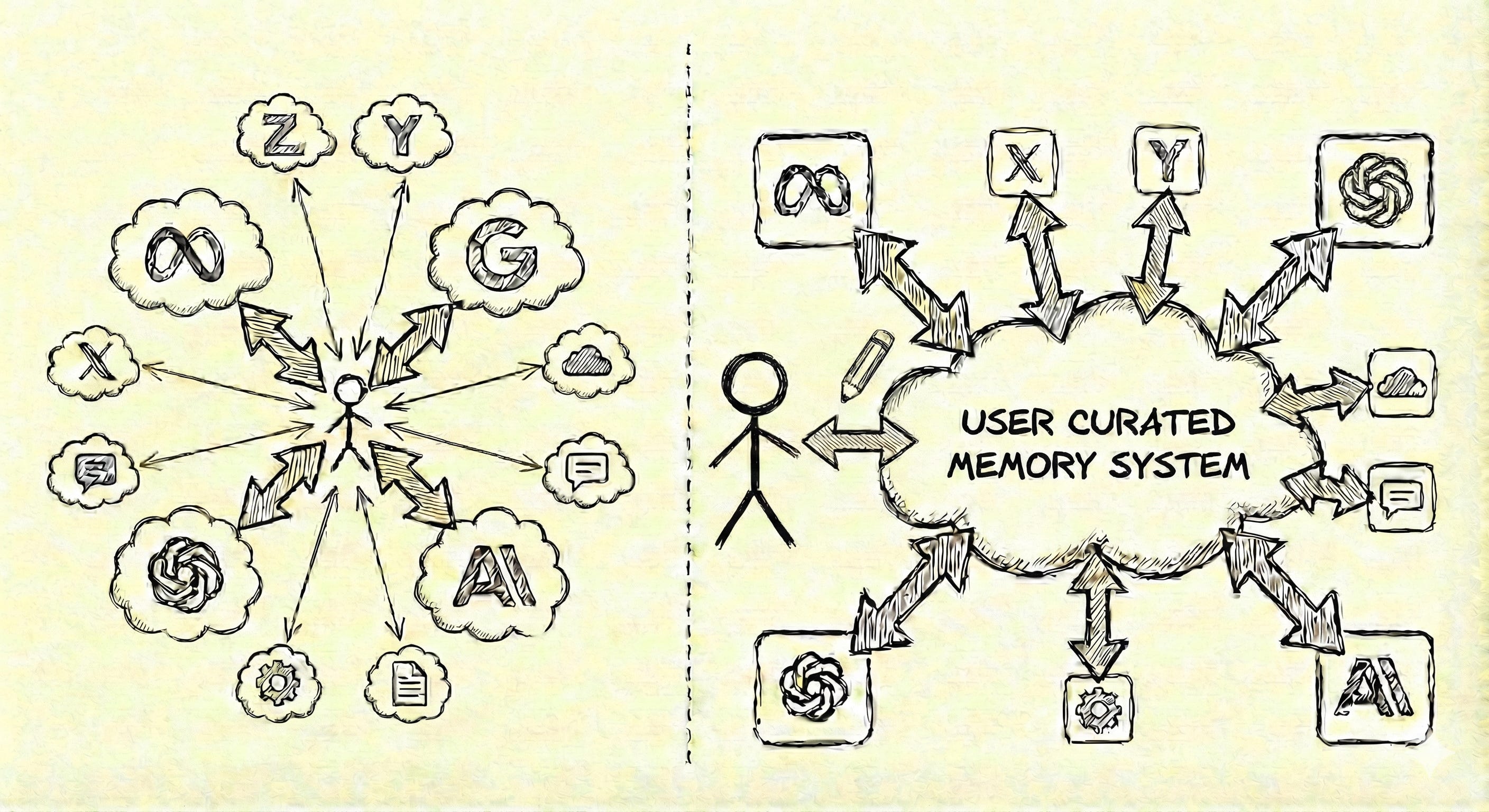
The AI context wars are heating up, and your favourite applications have no incentive to share proprietary context with each other.
But you do.
The cost of Gemini wrongly assuming that you love golf and recommending you golf clubs is low.
The bigger issue is that without curated personal context, many of the AI products we actually want won’t exist: spaces that respond to your mood, therapists that already know what’s going on in your life, and cooking apps that learn from what you leave uneaten, not just what you log.
Your context already matters to AI. With Fabric, you get to curate it in one place.
Interesting insights Eeshita. I like what you are saying and recommending. Curating / providing context for our social media content makes a lot of sense to me.
Keep up the good work, while I get curious about Fabric really is.
*BTW why don't you add a paragraph in your newsletters giving context to what it is, for people like me, who land directly on your content without knowing anything about you or Fabric?